Odonian principle of mutual aid and free association
The DispossessedThe Odonian principle of mutual aid and free association is the foundation of Anarres’s ideal social order: people depend on one another, share what they have, and associate without a governing authority. The novel tests that ideal against scarcity, the fear of outside influence, and the temptation to make the majority’s judgment binding on individuals. In Shevek’s account, freedom is not secured by withdrawing from others; it exists through mutual responsibility and the ability to act without rule.
Meaning and Practice
Shevek describes Anarres to a crowd in Nio Esseia as a society with no law beyond mutual aid between individuals and no government beyond free association. He names what that entails in institutional terms—no states, leaders, bosses, bankers, landlords, wages, charity, police, or soldiers—and stresses that Anarres is neither prosperous nor a society of powerful people. Its members are sharers, not owners. The principle therefore does not promise material abundance: it asks people to sustain one another without turning need into a market transaction or assistance into charity bestowed from above.
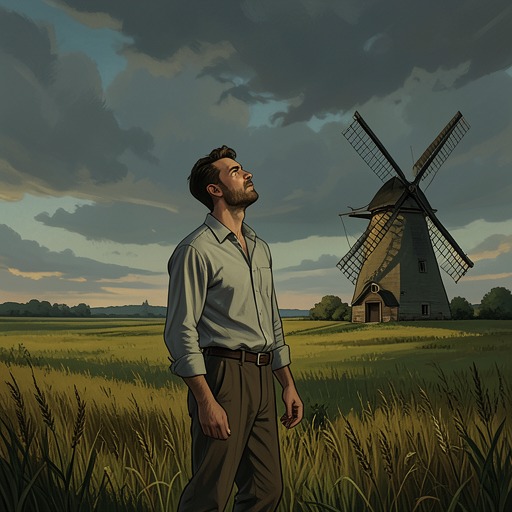
Shevek’s own arrival on Urras makes that difference concrete. With no money and nothing useful to offer as a gift, he calls himself the Beggarman and explains that, if his hosts choose to keep him alive, they must give him what he needs. He frames accepting care not as a failure of independence but as the ordinary consequence of belonging to a society that does not use money. Later, when offered clothes and other necessities, he again describes his arrival as coming with empty hands. The contrast is not simply between having and lacking possessions: it is between receiving through human obligation and obtaining through purchase.
Solidarity Under Scarcity
The principle is tested by the prolonged drought on Anarres. In Abbenay, water is rationed and directed toward keeping holum plants alive; food reserves have never been large, and hunger takes precedence over cleanliness. These conditions show the material setting in which mutual aid must operate: shared need is real, but resources are not inexhaustible.
A train carrying 450 travelers becomes a sharper test when it is stranded for twenty hours in a town of 160 people with no surplus food. The town depends on transport for food and cannot feed the newcomers without risking its own supply. The travelers receive nothing and go without food for sixty hours. The narrator identifies this as Shevek’s first experience of hunger: he had sometimes skipped meals by choice while working, but had never known meals to be unavailable. The episode does not erase the ideal of sharing; it shows the painful difference between the wish to share equally and the capacity to meet a need when scarcity threatens an entire community.
Solidarity Across Worlds
For Shevek, mutual aid also has a political reach beyond Anarres. When Chifoilisk warns that the Ioti welcome and support him for reasons of profit, Shevek says that he came to bargain with the system because he wants his people to come out of exile. He seeks solidarity and free exchange between Urras and Anarres, not the use of scientific achievement to enrich one side or secure power over another.
That commitment shapes his offer to share his theory. Shevek rejects the assumption that knowledge must be sold and asks whether it can instead be given to all the worlds and countries of Urras, so that no one government can use it to gain power, wealth, or military advantage over others. The gift is not an incidental gesture: it is his effort to make scientific exchange answer to common benefit rather than private profit. He insists that he will not spend his life serving greed or any master.
Freedom, Association, and Disagreement
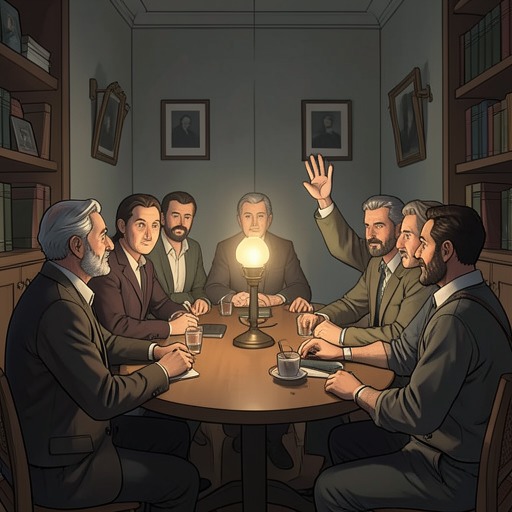
The principle is not treated as an easy guarantee of consensus. At a meeting in Abbenay, Rulag opposes allowing Urrasti to come to Anarres. She fears that contact could move from a few visitors to profiteers and eventually military occupation, and argues that the settlement terms have protected the society from that danger. The meeting accepts that the visitors will not be admitted. But Shevek then distinguishes that decision from the question of whether an Anarresti may travel to Urras: the settlement terms do not forbid it, he argues, and forbidding a harmless individual action would give the Production and Distribution Coordination authority it does not possess.
Shevek’s broader objection is that cooperation can harden into conformity when the majority’s preference becomes a rule. He argues that Anarres did not choose safety at the cost of freedom: if everyone must agree and work together in a prescribed way, society becomes machine-like. When an individual cannot work in solidarity with others, he says, that person has the duty and right to work alone. A society founded on revolution must remain capable of change, and that requires individuals to initiate acts and accept responsibility rather than submit to rule. The conflict with Rulag makes the principle’s difficulty plain: the right to act freely can seem to expose others to risks they did not choose.
The Principle as an Ongoing Test
Shevek’s address in Nio Esseia presents Anarres as evidence that a society without government, police, or economic exploitation is not merely an idealist’s dream. For the workers and political dissidents he addresses, the existence of Anarres carries hope; its name has become a wish for good fortune. Yet Shevek does not offer the society as a finished model to be adopted by copying its institutions. He tells his listeners that they must approach the future without property and give themselves to it: the revolution cannot be bought or manufactured as an external object, but must exist in people’s own spirit and relations.
The principle thus binds mutual support to personal initiative. It can demand sharing when people face need, as Shevek’s dependence on Urrasti hospitality demonstrates; it can also require protecting an individual’s freedom to dissent or act alone. The novel leaves that tension active rather than resolving it into a formula. Free association is meaningful only while association remains free, and mutual aid becomes a living social principle only when it is renewed through responsible action rather than enforced as obedience.